The up-to-date average score of the Technical evaluation is3.8points, and of the Artistic evaluation is3.5points, for a Total score of 7.3 points.
Comments sent with the Scores
Staff-Judges
Analysis - Comments
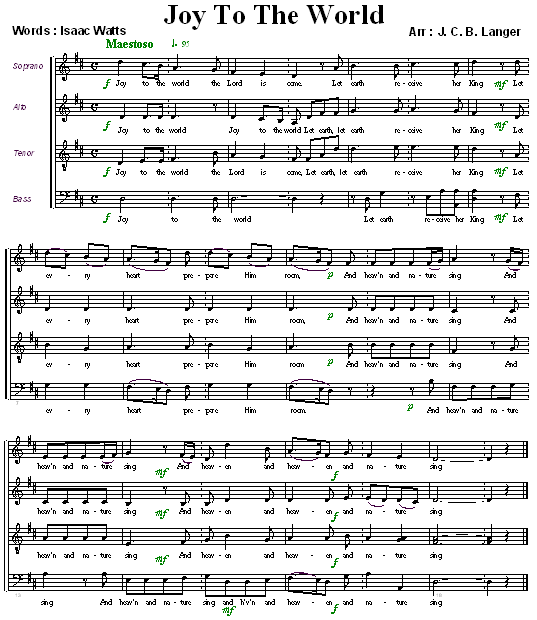
General Authors ofJoy To The World- There seems to be general agreement that the words are by Isaac Watts (1674-1748). However convincing arguments seem to establish that the music is NOT by Handel but by some unknown, extremely gifted musician. Form =AA', 2 Melodic Entities based on the same melodic motifs. For theA,,Level 0=0 + 5 with Bar-lines placed atLevel -2, 4 bars per cell, 7 bars (2 cells) in the completeA. For theA',,Level 0=0 + 3 with Bar-lines placed atLevel -1, 2 bars per cell, 13 bars (6 cells) in theA'. In this song,Level 0of theAcorresponds perfectly withLevel +1of theA'. That is why theAhas a bar less, 7 instead of 8, and theA'has a bar more (at the end), 13 instead of 12. This 8-bar + 12-bar grouping is a Fibonacci 5 structure (of 4 bars each), theA8 bars being divided into 4 + 4 and theA'12 bars divided into 4 + 4 + 4, a smallaba. Add 1 point for the successful Fibonaci form.
Melo-rhythm A=F=pF= pK2M(forcode) A largereboundingsplit cell, followed by a Kinetic / Masculine cell to close theA very much like thefirst 2 cells ofJingle Bellsbut on a larger level (with 4/4 bars). Only one Entity in theA, with very little Symmetry. A'=p2K2F= p2K2F= p2K2M p2K2M p2K2F= p2K2M All Kinetic cells - paired off Feminine-Feminine, Masculine-Masculine, Feminine-Masculine. Only one Entity in theA' because we have a Ternary structure here (a smallaba) and the Langer Hinge is at Bar 11 (the end of the firsta), with its Feminine Rhyme. The 2 Masculine Rhymes in Bars 13 and 15 are in the Bridgebof theA', where the Melo-rhythm is quite different from that of the rest of the
piece, which is fine, just at the right place. The Melo-rhythm of bars 16-17 is quite similar to that of Bars 8-9 and 10-11,
and the Melo-rhythm of Bar 18 (with its Pick-up) is the same as that of Bar
3, but placed on an Off-beat Bar rather than on a Beat Bar. The Entities are quite evident here, and the Symmetries are subtle and sufficient. Nice job -add 1 point, especially for the transition from the large to the small level (from Bar 7 to
Bar 8).
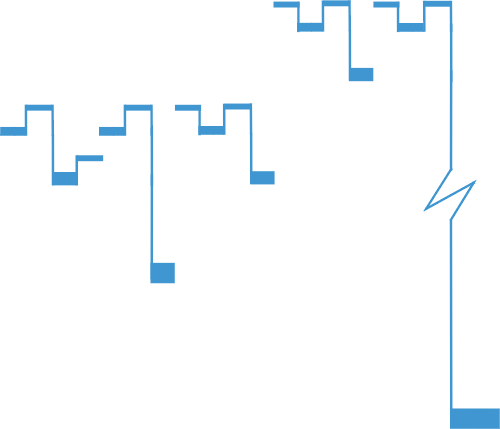
A look at theintegrated graphicsmight be helpful here. Each horizontal line, except the last, represents a 2/4 bar. NOTE theRebounding associationof Bars 3-4 and the Pick-up association of Bars 18-19.
The unusual 7-bar length of theAshould send a clear signal of change of level, from a larger to a smaller level, which has been made correctly, by starting the smaller level sooner, and not leaving it later as inSanta Claus. We even found one version of this song which added a bar here.
The use of appropriate 2-levelFootsiescan help to feel what is happening. Singing the song with one foot movement per 2/4 bar, start theAwithL T / R T, thenL T / R, (7 bars) and theA'will automatically start (and continue) withT / L T // Ras it should.
Melo-harmony The harmonies habitually suggested as the foundation of this melody are a complete
disaster. 1. They move at the very beginning, when they should not, and they remain static on the TONIC chord from Bar 7 to Bar 13, when they
should move, preferably at the rate of one chord per bar. 2. The harmonies in Bars 1-4 move as if they were at a smaller level, cadencing as if the piece were already over. 3. Bars 12 and 13 remain on the TONIC chord across aLevel 0Bar-line, and and Bars 14 and 15 remain on the DOMINANT chord across aLevel +1Bar-line. 4. Only the cadences are appropriate - the chords G, A7, D, in Bars 5-7, at the end of theA, and the chords Em, D, A7, D, in Bars 18-19(20) with the Pick-up, at the end of theA'. Now, what should the harmonies be ? 1. Bars 1-4 should all be on the TONIC chord, preferably with a pedal in the
Bass Voice, the inner voices producing polyphony with different note-values, possibly
different words. 2. Bars 8-9 and Bars 10-11 (a repeat) should use the COUNTER / TONIC swing (G
/ D) with this specific Melo-line, to have the Orbit Lines0-1and2-1across theLevel 0andLevel +1Bar-lines. 3. Bars 12-13 should use Orbit Line0(3) 3-2with the chords Bm / F#m, and Bars 14-15 should use the same0(3) 3-2Orbit Line with the chords A / Em with anopen Metamorphosis 4between the F#m and A chords. 4. In Bars 16-17, by repeating the COUNTER / TONIC swing (G / D) of Bars 8-9
and 10-11, we also continue the harmonic sequence of Bars 12-13 and 14-15, with another open Metamorphosis 4, this time between the Em and G chords. The complete chord sequence is thus D / D / D / D / G / A7 / D / G / D / G / D / Bm / F#m / A / Em / G / D Em / D A7 / D / (D). NOTE that thechord patternof the Bridge Bm / F#m / A / EmM3*9 (the nextcell, G / DM6, is included, being the continuation of the pattern) is the inversion of C / F / Dm / GM71, the chord pattern of the Bridge ofSanta Claus Is Comin' To Town (without the repeats and the dominantization).
NOTE also that, starting from Bar 8, the progressions in eachcell, except the very last, are sharpening (ascending) progressions (the complete Tetrads would have sixths instead of sevenths). One must not be surprised that it has remained a secret for so long.
It would seem unfair to remove points for the faulty harmonies which have been perpetuated by the arrangers of this anonymous (possibly
folkloric) melody. However, one could easilyadd 1.5 pointsfor an appropriate harmonic structure.
Melo-lines Rather than fundamental, structural Orbit Lines, this melody makes exhaustive use of surface melodic contours which can exist on different harmonic structures depending on their rhytmic position. For all practical purposes, it is built on a scale, or fragments thereof. 1. Bars 1-4 are built on a complete, octave-length descending scale, from D to
D, all on the TONIC D chord. 2. Bars 5-7 are built on a fourth-length ascending scale, from A to D, on the cadential COUNTER / DOMINANT / TONIC, G / A7/ D chords. 3. Bars 8-9 and 10-11 are built on a sixth-length descending scale, from D to
F# reminiscent of the opening phrase, on the "plagal" COUNTER / TONIC cadence, G / D. 4. Bars 12-13 and 14-15 (the small Bridge) are built on a third-length ascending
scale, on a sequential "plagal" pattern, ANTE-2 / ANTE-3 / DOMIINANT / ANTE-1, with a change of melodic direction and added repeated notes, exactly what is needed for a Bridge. 5. Bars 16-17 are a variation of Bars 8-9 (and 10-11), imposed by the octave jump which is required, on the same "plagal" COUNTER / TONIC cadence, G / D, also, almost miraculously, the extension of the preceding Bridge chord
sequence. 6. Bars 18-19(20) are melodically the exact repeat of Bars 3-4, but, this time with the cadential ANTE-1 / TONIC64, DOMINANT / TONIC - Em / D, A7/ D.
Review of Entities In theA, Melo-rhythm has 1 2-cell entitiy, Melo-harmony has 1 entity,M54, Melo-lines has 1 entity, the three entities are the same. In theA', Melo-rhythm has 1 entity of 6 cells, Melo-harmony has 1 entity,M663*964 Melo-lines has 1 entity,Orbit 1-Orbit 1, at the end the three entities are the same. This might seem excessive under normal circumstances, but the irregularity of the Fibonaci structure, the scale ending in the middle of theA, the masculine rhymes in the Bridge of theA', all create diversity and attenuate the coincidence of the Entity lengths.
You might like to see, and hear, what this version is like.
In order to compare this new version with one using the original harmonies, you can click to hear atypical arrangement.
Scores
In the technical evaluation - full points kept -5 In the artistic evaluation - 2 points were added. Total score = 7 points With adequate harmonies, the score would be8.5points.
Double Quality Control The first Quality Control was our evaluation of the piece. The second Quality Control is your evaluation of Analysis, did you find it convincing, valid, and fair? Which version of the song did you prefer? Let us know, we will print your comments.
Comments and Questions after reading this Revised Page
The concept of uneven A - B sections is completely new to me.