|
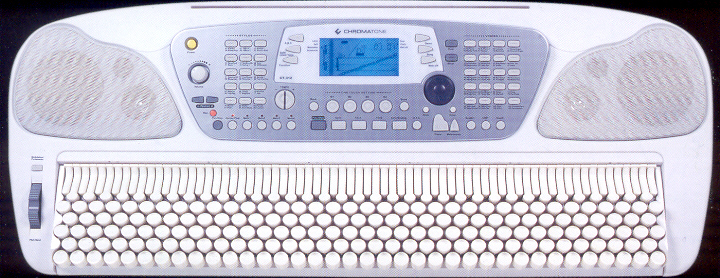
Keyboard Dispositions
The standard 88 keyboard consists of 2 rows: a front row of 7 white keys and
a back row of 5 black keys per octave. It was evidently conceived to favor the natural
diatonic system (on the front row) with each added sharp or flat note requiring a
foray into the black keys (of the back row).
The Janko Uniform Keyboard consists fundamentally of 2 rows of 6 keys, each row
in the form of a whole-note scale, disposed in a staggered position, a half-tone from
its neighbor. This set of 2 rows is then presented 3 times, 6 rows in all.
Painting
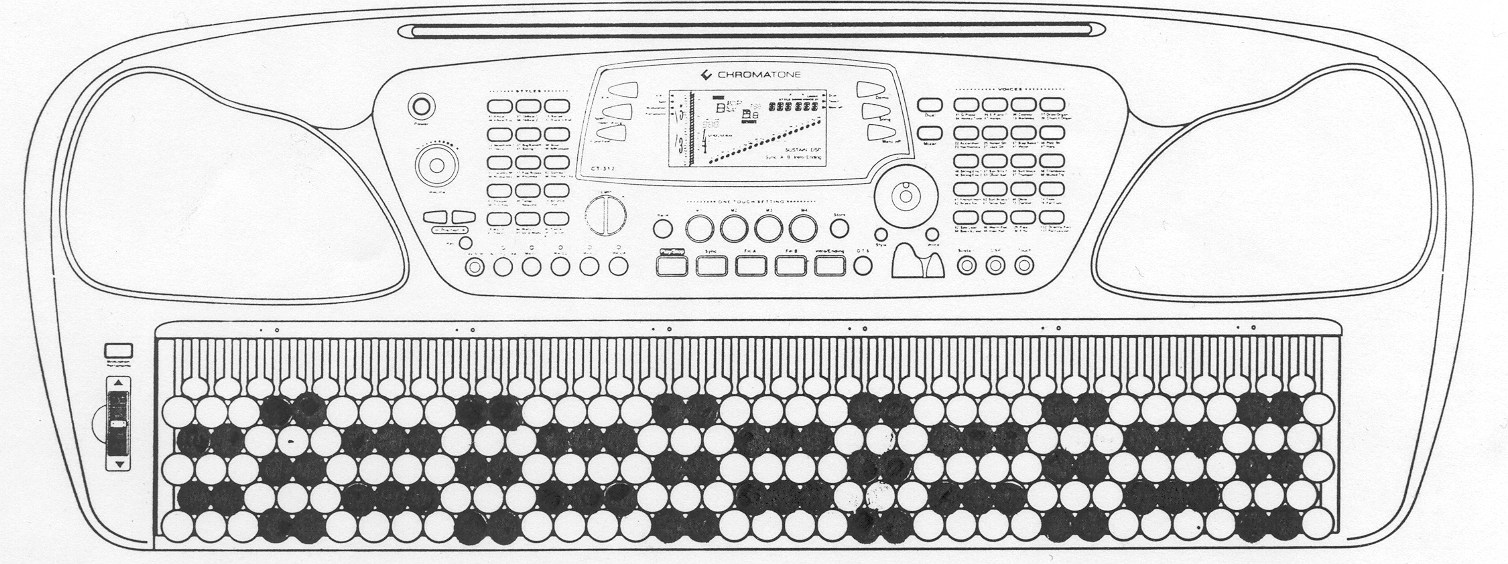
On the Chromatone keyboard, all the keys are white, which might be disturbing
to someone used to the reference points of the black keys. Nothing presents one from
painting the appropriate keys black, as they are easily detachable from the supporting
frame.
However, while initiating young children to this keyboard for the first time,
it might be preferable to leave all the keys white, so as not to prejudice the child
toward the system of natural notes (all systems becoming the same with this new disposition).
Rows
Identifying the six rows with lower-case letters (to avoid confusion with note
names in upper-case) we would have, moving up and inward, rows "a", "b", "c", "d",
"e", and "f" (which consists of protrusions of the frame, rather than removable heads).
Rows a, c, and e are identical (with the whole-tone C#D# and the tritone FGAB),
and rows b, d, and f are also identical (with the ditones CDE and F#G#A#).
Fingering
Basically, to suit the ergonomic exigencies of the adult human hand, 2 front
rows (not necessarily the first 2) are reserved for the thumbs, and the next 2 rows
are reserved for the 4 other fingers. Small (children's) hands may compact this 4-row
disposition into 3 rows as we will later see in specific exercises.
The fingering possibilities are so numerous on this keyboard that all the fingerings
presented here are merely suggestionsand the performer is strongly encouraged to find his own, personal fingerings.
Language
While we are at it, it might also be preferable to use a relative language (like
the movable DO or scale-degree numbers) when we give examples for the uniform keyboard,
rather than the usual absolute language (of note names and graphic note positions
on staves).
The most efficient and logical relative language seems to be theVocentro, which is presently used inSingAlot. Some Vocentro phonema (ex:Ta, Vo, Ti) will appear in the first exercises.
A new 3-lineVocentro staffhas been divised for this relative language which is perfectly suited to the uniform
keyboard and which will also be used in some of the exercises.
Scales
Thinking in terms whole-tone rows, the major diatonic scale is composed of a
"ditone" (ex: the notes C, D, E, or inVocentro
Ta, Vo, Ti) in one row, followed by a "tritone" (ex: the notes F, G, A, B, orNa, Ra, Ri, Ni) in an adjacent row.
The most convenient place for the thumb is on the first and last notes of the
tritone (F and B, orNaandNi), so as to play them both in the same row (as one would play the scale of F# major
on a standard 88 keyboard). The ascending C major scale would have the following fingering
(in rows acd): for the right hand, CDE (Ta Vo Ti) with d234, then FGAB (Na Ra Ri Ni) with a1c23a1; and for the left hand, CDE (Ta Vo Ti) with d432, then FGAB (Na Ra Ri Ni) with a1c32a1.
All major scales could be fingered the same way. This is by no means the only
way to finger this scale, but it seems the simplest and most convenient. Transposition
does not require any change of fingering. For a whole-tone, higher or lower, one remains
in the same 4 rows, and for a half-tone, higher or lower, one moves (in or out) to
the next set of 4 rows.
On to the Exercises
|
