The up-to-date average score of the Technical evaluation is3.6points, and of the Artistic evaluation is2.7points, for a Total score of 6.3 points.
Comments sent with the Scores
None yet
Staff Judges
Analysis - Comments
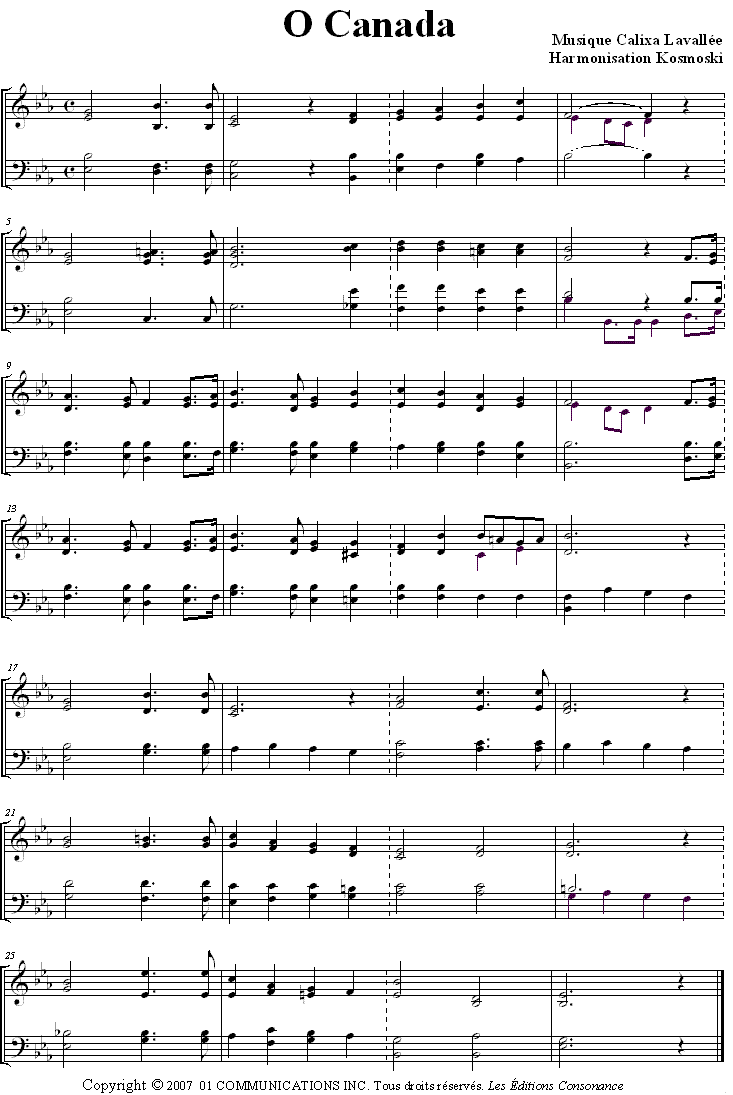
General - the Canadian National Anthem Original French words by Adolphe-Basil Routhier, music by Calixa Lavalée, 1880 English words by Robert Stanley Weir, 1908. The form =A A' A'', two 8-bar (4-cell) sections and one 12-bar (6-cell) section, with a return of the original melodic motif at the beginning of theA''. Back to the original music page
Melo-rhythm Level 0bar-lines are indicated "/" andLevel -1bar-lines are indicated "\". Bars 1-8 consist of. / . \ / , presented twice, for the opening, principal theme, two 4-bar RhythmicEntities. Bars 9-12 consist of. \ .. / . \ / ., with bars 13-16 quite similar. \ .. / . \ / , thebeing merely melismas of the original. two 4-bar Rhythmic Entities. Bars 17-20 consist of the opening. / , twice, and bars 21-28 consist of. / \ / , twice, to close the piece. aMIMI MA MA, of two 2-bar and two 4-bar Rhythmic Entities.
Melo-harmony The problem here is anticipating cadences,The Winter Syndrome- Bars 1-8 consist ofI V / VI, V \ I II I IV / V \ I II7 / V, I \ V II7 / V, whereII7is aVofV. In bar 6, the harmonies go prematurely to theVchord, anticipating the full cadence toVin bar 8. It seems preferable to cadence to theIIIchord in bar 6. 1 point lost here. Bars 9-16 consist ofV7 / I \ IV I V7 I / V \ V7 / I \ V II7 / V, whereII7is once againVofV. Bars 17-28 consist ofI / IV \ II / V \ I I+ / IV \ I V7 / I \ I / IV \ I V7 / I. In bars 23-24, the harmonies go prematurely to theIchord, anticipating the full cadence toIin bar 28. Here again theIIIchord, this time major, is preferable in bar 24. 1 point lost here. Only one large Harmonic Entity for the whole piece, all the more reason to avoid the chord ofIin bar 24.
Melo-lines The contours of the Melo-lines seem well disposed, with theAand theA'contrasting as they should, and theA"showing considerable symmetry with theA, with the appropriate Melo-rhythm changes for the ending. Add 1 point here.
Review of Entities Theentitiesare quite unusual here, with a variety of Melo-rhythm Entities and only one large Entity in both Melo-harmony and Melo-lines. Add 1 point here.
New Look-Sound
NOTE The inverse symmetry between bars 1-2 and 5-6 in the Soprano and Bass voices - the notes G-Bb-Eb and Eb-D-C in bars 1-2 and G-A-Bb and Eb-C-G in bars 5-6, in both cases, intervals of tenth, thirteenth, and tenth. The chord of G (major) in bar 24, instead of the chord of Eb, is preceded byV7 / I IV I V7 \ VI II7 / V, in the key of Cm, in bars 21-24, so as to prepare the final chord of G, which leaves the harmony open.
Scores
In the technical evaluation - 2 points were lost,5 - 2 = 3 In the artistic evaluation - 2 points were added. Total score = 5 points
Double Quality Control The first Quality Control was our evaluation of the piece. The second Quality Control is your evaluation of Analysis, did you find it convincing, valid, and fair? Let us know, we will print your comments.


 .
. /
/ 
 \
\