The up-to-date average score of the Technical evaluation is1.8points, and of the Artistic evaluation is2.6points, for a Total score of 4.4 points.
Comments sent with the Scores
None yet
Staff Judges
Analysis - Comments
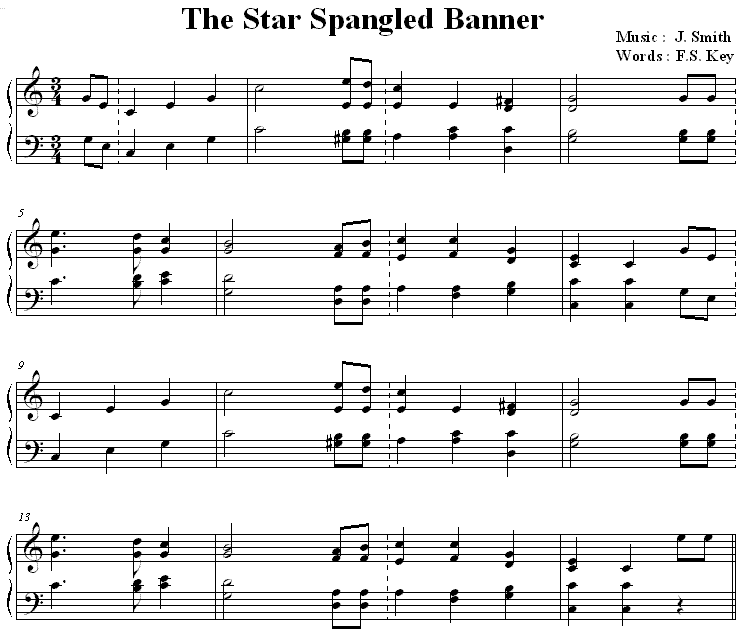
General The American National Anthem - lyrics written in 1814 by Francis Scott Key, -set to the tune of the old British drinking song "The Anacreonic Song", which was also popular in America at the time. It was recognized for official use by the Navy in 1889 and the President in 1916, and was made the national anthem by a Congressional resolution on March
3, 1931. Form =AAA'A", 4 sections of 8 bars each, 3 Melodic Entities based on different melodic motifs, with strong reminiscences ofWe Wish You A Merry ChristmasandThe First Noelin theA". With a range of one and a half octaves, it is known for being notoriously difficult
to sing. It is one of the few national anthems to have a regular binary structure. Back to the original music page
Melo-rhythm If one discounts the occasional "spreads" of. forand.
for, in the first 3 sectionsAAA', the melo-rhythm / / is constant, with. at the beginning and in bars 2, 8, and 10, in some versions, and with. in bars 5, 13, and 21, in all versions. However, theFemininerhyme, instead of the Masculine rhyme is inappropriate in bars 8 and 16 at the end of eachAsection, remaining open precisely where it should close. 1 point lost here. In the fourth sectionA", we find a Feminine rhyme in bars 26 and 28, and a Masculine rhyme in bars 30 and 32, a preferable balance, a melorhytm
of / / / / / . / / / (with the "spread". in bar 31).
Melo-harmony The first (repeated) 8-bar phrase consists of :I / I III7 / VI II7 / V / I / V7 / I / I, where theIin bar 7 (and bar 15) comes in too soon, the cadence belonging in bar 8 (and bar 16). 1 point lost here. The third 8-bar phrase starts with a carbon-copy of theJoy Syndrome:I / I / V7 / V7, which stagnates onIfrom bar 17 to bar 18, and onV7from bar 19 to bar 20, where there should be movement within acell. 1 point lost here. Bars 21-22 are the same as bars 5-6, and bars 23-24 are the same as bars 3-4, creating unusual, disorganized symmetries. The fourth 8-bar phrase, as previously stated, borrows heavily from old Christmas
tunes, with the chord pattern :I / IV / II / V7 / I / I IV / I64 V7 / I, quite permissible by itself, but out-of-place with the style of the other
3 sections, changes being preferably located in the third quarter and not in the
fourth.
Melo-lines The first (and second)Aopens and closes with tonic arpeggios, with 2 sixth jumps in between, which gives it an agressive, confident feeling. Add 1 point here. On the other hand, the first 4 bars of the followingA'is all by step, which gives it a lyrical, tender feeling, at an appropriate place in the piece, in the third quarter. Add 1 point here. As previously seen in the Melo-harmony, Bars 21-22 are the same as bars 5-6, and bars 23-24 are the same as bars
3-4, creating unusual, disorganized symmetries. A half-point lost here. TheA", as previously stated, borrows heavily from old Christmas tunes, out-of-place with the style of the other 3 sections, placed in the fourth quarter. A half-point lost here.
Review of Entities As previously seen, the first (and second)Aends with an inappropriate Feminine Rhyme, and with theIchord a bar too soon. In theA', the "Cross-symmetry" of bars 21-22 with 5-6, and bars 23-24 with 3-4, is certainly not recommended. However, the Melo-harmony remaining open on theVchord, confers an appropriate Bridge feeling on the third quarter. TheA"closes well but is not, as previously stated, in the appropriate style.
New Look-Sound
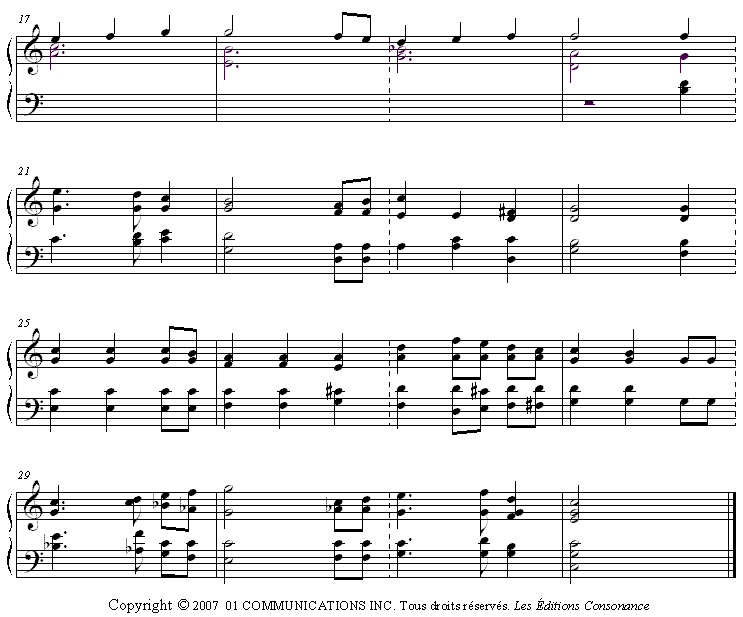
This is how the piece would look and sound with the suggested changes. Bars 1-2 are presented in octaves. The bass of bar 5 is changed for a more "Mozart feeling". The harmony of bar 7, with its pick-up, is changed fromV7 / I, I, I toII / VI IV V, with theIVa Deceptive Triad ofII, in order to retard the cadence to bar 8. The harmony of bars 17-20 is changed fromI / I / V7 / V7 toVI / III / V-3 / II, in order to avoid theThe Joy Syndrome. The harmony of bar 29, still essentially on the chord ofI7, alternates with the chord ofIV-3, paving the way for theIV-3on beat 3 of bar 30.
Scores
In the technical evaluation - 4 points were lost,5 - 4 = 1 In the artistic evaluation - 2 points were added. Total score = 3 points
Double Quality Control The first Quality Control was our evaluation of the piece. The second Quality Control is your evaluation of Analysis, did you find it convincing, valid, and fair? Let us know, we will print your comments.

 .
. 
 .
.