The up-to-date average score of the Technical evaluation is3.8points, and of the Artistic evaluation is1.9points, for a Total score of 5.7 points.
Comments sent with the Scores
None yet
Staff Judges
Analysis - Comments
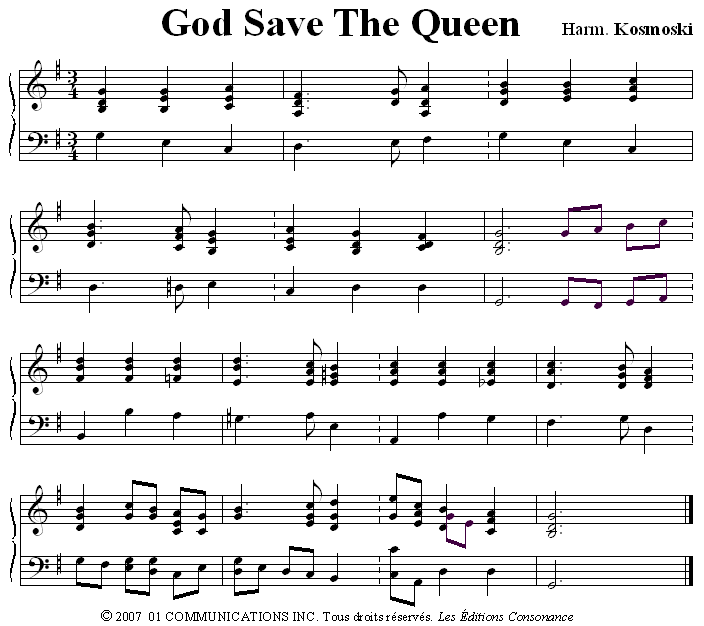
General - both words and tune are anonymous, probably of theXVIIcentury, and there is no authorized version of the British National Anthem. The words ofAmericaare by Samuel F. Smith, and the music is fromGod Save The Queen. Form =AA', 2 Melodic Entities based on similar melodic motifs. Back to the opening page For both theAand theA',Level 0=0 + 3, with Bar-lines placed atLevel -1, 2 bars percell, 14 bars (7 cells) in the complete tune. This 6-bar + 8-bar grouping is the result of incompleteablationat a smaller level, in which the first quarter has only been removed from the first half, leaving a 3-cell group and a 4-cell group from the original two 4-cell
groups. (Bar-lines atLevel 0are indicated "/", and atLevel -1are indicated "\".)
Melo-rhythm There is very little variety in the Melo-rhythm. The basic antecedent cell, / . (K2 F+), with itsFeminine Rhyme, occurs in cells 1, 2, 4, and 5, and its consequent counterpart / . (K2 M), with its Masculine Rhyme, occurs in cell 3. Cells 6 and 7 have slightly more elaborate Melo-rhythm, / . \ / .(K3 F+ K3 M), (merely melismas, still fundamentally / . \ / .), with the appropriate Feminine and Masculine Rhymes. There are 2 very clearly defined Melo-rhythmic entities. Unfortunately, the first 3-cell entity does not seem clearly defined as a 1-2
grouping, and the place to start this analysis is in the 2-level, 4-cell, Antecedent-Consequent structure,aA cA aC cC, composed ofKF KF KF KM. The openingKF KFis identified as a fundamental binary grouping,aA cA, and the followingKF KMconfirms this,aC cC. However, when the ablation reduces this 4-cell pattern to 3 cells ofKF KF KM,cA aC cC, the openingKF KFis still identified as a fundamental binary grouping,aA cA and the followingKM,cCcontradicts this and corrects the opening tocA aC, a rather unpleasant and disturbing sensation. Remove half a point here. A very cautious proposal of change appears in the Melo-harmony, below.
Melo-harmony There are a great many secondary chords in the Melo-harmony of this piece (indicated
in parentheses), especially in the Off-beat of each cell. Cell 1 consists ofI (VI II) / V, thus essentiallyI / V, a typicalantecedent. Cell 2 consists ofI (VI II) / (V64 III7) VI , theIII7being aVofVI, thus essentiallyI / VIorI / I, possibly anantecedent or aconsequent. NOTE that it is the only cell in the piece to have such important secondary
chords in the Beat. Cell 3 consists of(II V64) V7 / I, thus essentiallyV / I, a typicalconsequent. Back to the faulty 2-1 ternary grouping seen in Melo-rhythm, which should conform
tocA aC cC, - The only ternary solution seems to be to invert cells 1 and 2, having them
placed 2-1-3, with appropriate harmonic simplification in the opening cell 2. Conforming toaA cA aC cC, a quaternary disposition of cells 1-2-1-3 would also be possible, again with appropriate harmonic simplification in cell 2. Both suggestions seem too deforming to be taken seriously. Solutions are more evident in the second entity of the piece - Cells 4 and 5 (bars 7-10) seem a clear case ofThe Joy Syndrome, with harmonies ofI / I (V) I , V / V (I) V, essentiallyI / I , V / V , which can be replaced byIII / VI7 (II) VI , II / V7 (I) V, essentiallyIII / VI , II / V , withVI7being aVofII. Remove 1 point here. Cell 6 consists ofI (IV) / I (IV) I, Cell 7 consists of(II V64) V7 / I, the same as cell 3.
Melo-lines It is not easy to establish, much less to evaluate, the Melo-lines, not being sure of the proper Melo-harmony, only cells 3 and 7 seeming appropriate. The melodic contours are mostly by step, as inJoy To The World, but, in this case, seem to wander up and down, rather aimlessly.
Review of Entities There are only 2 entities in this piece, for the Melo-rhythm, the Melo-harmony, and the Melo-lines, certainly not much variety or contrast. Add 1 point for the consistency of the majestic mood.
This is what the new version would look and sound like.
Scores
In the technical evaluation - 1.5 points were lost,5 - 1.5 = 3.5 In the artistic evaluation - 1 point was added. Total score = 4.5 points
Double Quality Control The first Quality Control was our evaluation of the piece. The second Quality Control is your evaluation of Analysis, did you find it convincing, valid, and fair? Let us know, we will print your comments.
Comments and Questions after reading this Results page



 .
.